Bubble Sort
Speed SlowDifficulty Easy
Worst-Case Time Complexity: O(n^2)
Best-Case Time Complexity: O(n)
Space Complexity: O(1)
Creator: Stephen Cook
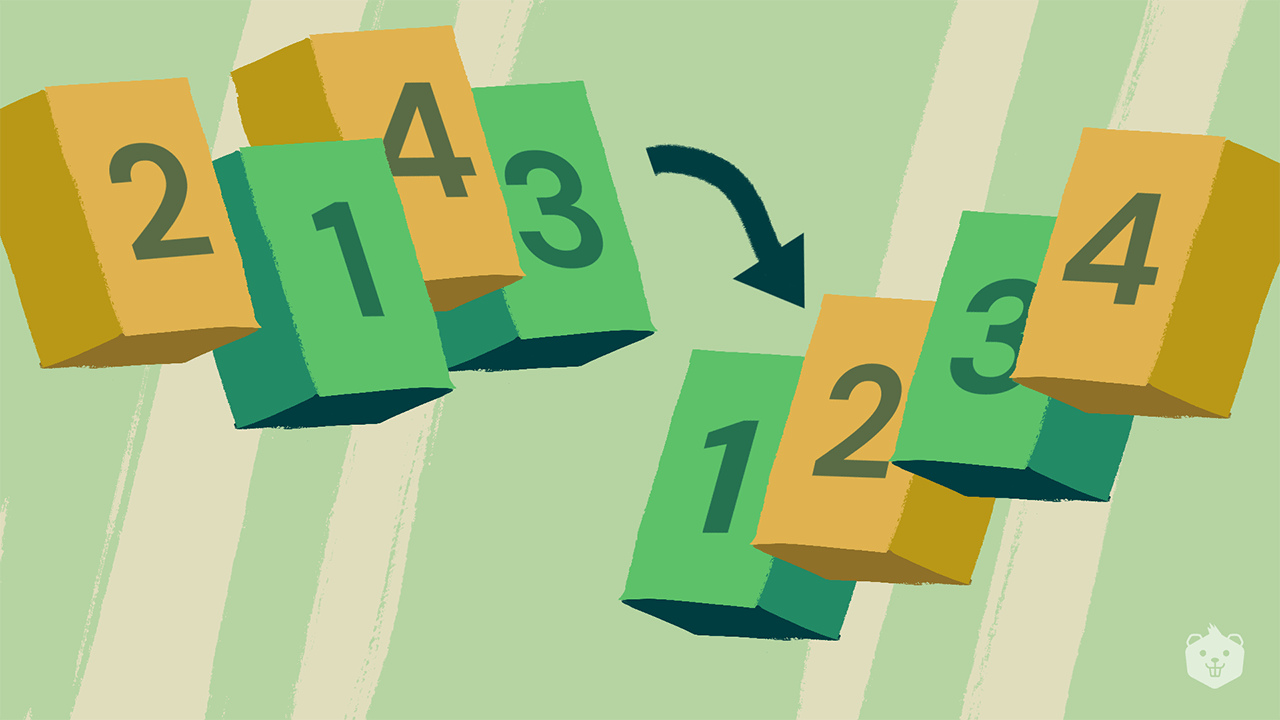
Bubble Sort is a simple sorting algorithm that repeatedly steps through the list, compares adjacent elements, and swaps them if they are in the wrong order. It is named for the way smaller elements "bubble" to the top of the list. Developed by computer scientist Stephen Cook and mathematician Leonid Levin in 1969, Bubble Sort is often considered one of the simplest sorting algorithms to understand and implement. However, its efficiency is limited, making it less practical for large datasets.
The algorithm's creator, Stephen Cook, is renowned for his contributions to theoretical computer science and the theory of computational complexity. While Bubble Sort is straightforward, its time complexity is O(n^2), where n is the number of elements in the list. This makes it less efficient compared to more advanced sorting algorithms such as QuickSort and MergeSort, which have average time complexities of O(n log n). Bubble Sort is primarily used for educational purposes and not recommended for large-scale applications where efficiency is crucial.
In comparison to more efficient sorting algorithms, Bubble Sort's simplicity comes at the cost of performance. QuickSort, for example, employs a divide-and-conquer strategy, breaking down the sorting task into smaller subproblems and solving them independently. MergeSort, on the other hand, combines sorted sublists to produce a fully sorted list. These algorithms generally outperform Bubble Sort in terms of speed, making them more suitable for real-world applications where sorting large datasets quickly is essential. While Bubble Sort serves as a fundamental introduction to sorting algorithms, its impracticality for large datasets makes it less favored in professional software development.
Selection Sort
Speed MediumDifficulty Easy
Worst-Case Time Complexity: n^2
Best-Case Time Complexity: n^2
Space Complexity: O(1)
Selection Sort is a straightforward sorting algorithm that repeatedly selects the minimum element from an unsorted portion of the list and swaps it with the first unsorted element. This process continues until the entire list is sorted. The algorithm's simplicity makes it easy to understand and implement, making it a common choice for educational purposes and small datasets. However, its time complexity of O(n^2) makes it less efficient than more advanced sorting algorithms for larger datasets.
The origins of Selection Sort are not tied to a single individual, as it is a relatively intuitive and elementary sorting technique. The algorithm has been known and used since the early days of computer science education. Its simplicity allows students and beginners to grasp fundamental sorting concepts, but in practical applications, it tends to be overshadowed by more efficient algorithms like QuickSort and MergeSort.
In comparison to other sorting algorithms, Selection Sort is less efficient when dealing with large datasets due to its quadratic time complexity. Algorithms like QuickSort and MergeSort, with average time complexities of O(n log n), offer better performance for larger datasets. Selection Sort's main advantage lies in its simplicity and ease of implementation, making it suitable for small lists or educational purposes. However, in real-world scenarios where efficiency is crucial, more advanced algorithms are often preferred.
Insertion Sort
Speed MediumDifficulty Easy
Worst-Case Time Complexity: n^2
Best-Case Time Complexity: n
Space Complexity: O(1)
Insertion Sort is a simple sorting algorithm that builds the final sorted array one item at a time. It iterates through the input list, removing one element at a time and placing it at the correct position within the sorted portion of the list. This process continues until the entire list is sorted. Developed by computer scientist John Mauchly in 1945, Insertion Sort is known for its simplicity and efficiency on small datasets or partially sorted arrays.
The creator of Insertion Sort, John Mauchly, was a significant figure in the early days of computer science. He is perhaps best known for his co-invention of the Electronic Numerical Integrator and Computer (ENIAC), one of the earliest general-purpose electronic digital computers. Insertion Sort is particularly useful for small lists or nearly sorted datasets, where its simplicity and adaptive nature allow for efficient sorting. However, its average and worst-case time complexity of O(n^2) makes it less suitable for larger datasets compared to more advanced algorithms like QuickSort or MergeSort, which have better average-case performances.
In comparison to other sorting algorithms, Insertion Sort holds its own in certain scenarios. It performs well on small datasets or when elements are already partially ordered. Unlike algorithms with higher time complexities, Insertion Sort can be more efficient in these specific cases. However, for larger datasets, more advanced algorithms with better average-case time complexities, such as QuickSort and MergeSort, are generally preferred in professional software development due to their superior performance in a broader range of scenarios.